
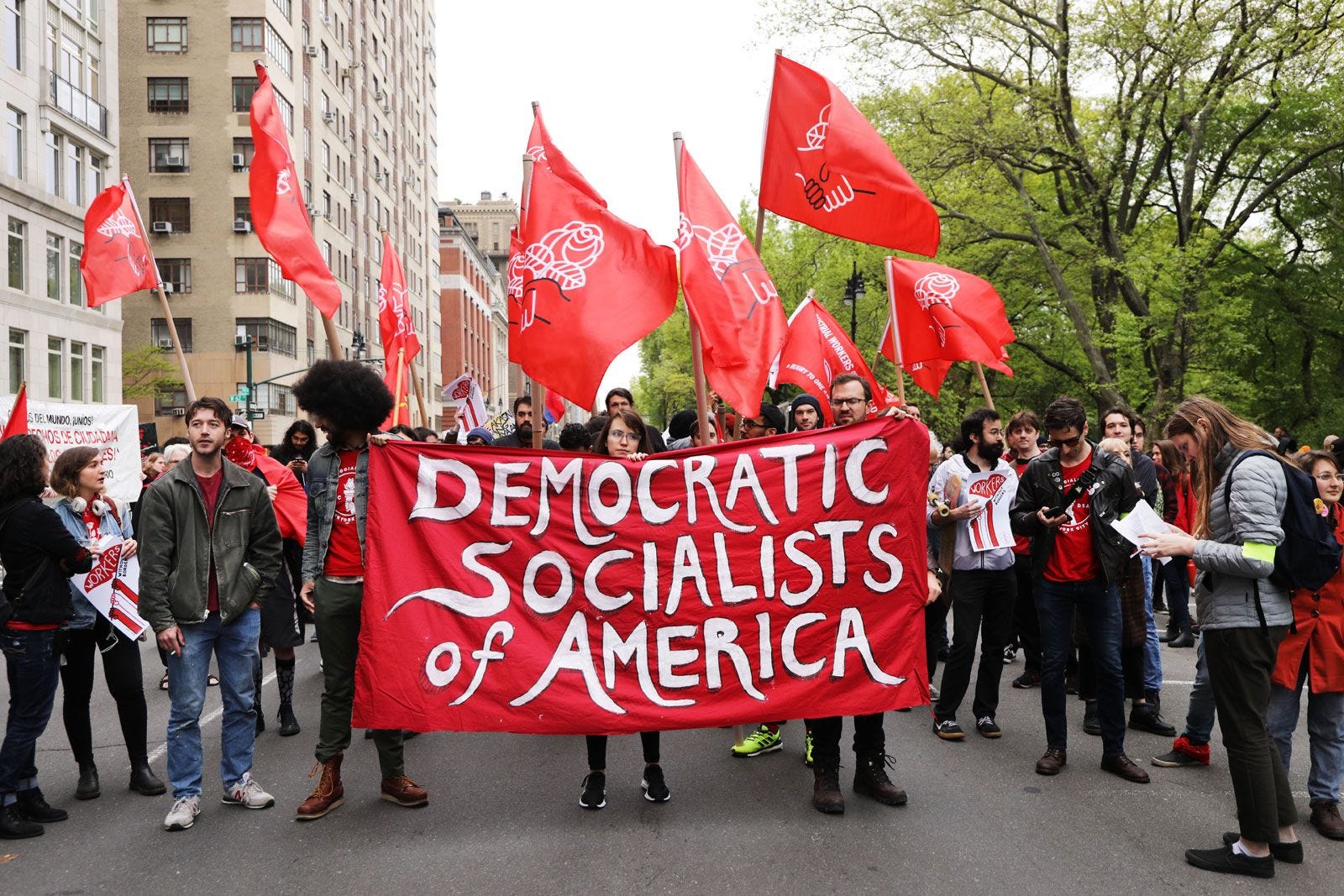
“Socialism is more popular than ever in the US., according to polls” reports Time Magazine’s Miranda Jeyaretnam. 43 percent of Americans have a positive view of socialism according to a Gallup poll that tracks the metric, the highest rating since 2010. Jeyaretnam points to not only Zohran Mamdani’s victory in the New York City mayoral race but also the victories of all three of his endorsed candidates over establishment Democrats in NYC primary races.
Many Republicans, desperate to distract voters from Trump’s war with Iran, his disastrous economic policies, and the economic pain both have inflicted, have latched onto this “rise of socialism” as a campaign theme.
This from the party which routinely increases federal spending twice as fast as the Democrats when it controls the White House and Congress.
There is probably some reason for concern that overt socialists are winning elections in deep blue districts, but socialism has always been popular with large segments of the population. So has Santa Claus, the Easter Bunny, and the tooth fairy, with equal real-world results.
It’s not like socialism has never been tried in the United States, either. From the Jamestown and Plymouth colonies at the dawn of American history through the early 20th century, over 100 socialist experiments were launched in America. All failed as miserably at the micro level as socialism did at the national level.
Conversely, every country that tried socialism in the 20th century, suffered for it, but then turned their country around, from China and India to the Scandinavian countries and Canada, had one thing in common: turning away from socialism to more market-oriented economic policies.
Socialism’s deluded defenders like to point to the remnants of socialism in places like Sweden or Canada and claim those remnants “work.” But those are the constants. They had those pre-early 1990s before the nations in question dramatically cut government spending and regulation and privatized large sectors of their economies. The question to ask is what is different today from socialism’s apex in the 1960s – 80s?
When I was a child in the 1970s, my mother used to routinely admonish me not to waste food because “there are people starving in China.” Nobody’s mother says that anymore. Why not?
On the contrary, politicians now (wrongly) tremble in fear that China will overtake the U.S. as the richest country in the world. What’s different now from Mao’s China of the 1970s?
Everyone knows the answer to these questions. The reason China, India, Canada, Sweden, and dozens of other countries have richer, more vibrant economies now than they did in the mid-20th century is they are all more capitalist than they were then. 1.5 billion people have escaped extreme poverty since 1990, and they all live in countries that became less socialist and more capitalist.
No, these countries are not laissez faire. But they succeed despite what socialism remains from their destitute past, not because of it. And they succeed today because they’ve become less socialist. There is simply no disputing this anymore.
Socialism cannot survive evidence or reason, but it makes people feel good. And feelings are much more powerful than reason. There are times when this writer wonders how the original American republic ever happened at all.
If you can get an entire population making political decisions based upon irrational feelings that evidence and reason wholly invalidate, you can make a lot of money off them. And that’s just what the plutocrats at the top of the economic food chain have done since the dawn of the Progressive Era.
Socialists have been their useful idiots.
There is a tendency for those who might agree with this statement to conclude that the problem with American politics is it is controlled by “the rich” who bribe the government to act in their interests instead of the interests of “the people.” This also makes people feel good because then the sad state of the American republic is not their fault. But it is their fault.
Yes, said elites play the people for their own ends, but they don’t ultimately make political decisions. The voters do. And the voters continually vote against their own interests, particularly those who believe socialism is superior to capitalism in the face of overwhelming evidence to the contrary.
So-called “everyday Americans” need some tough love. To the extent their living standards could be higher and their lives easier with a different political and economic framework, they are 100 percent to blame. It is their own moral and intellectual failing that has produced the modern confiscatory state. Blaming someone else and expecting a politician to right that imaginary wrong is only going to make it worse.
Calling the growth of the American corporate state “progressive” was the oldest trick in the American political book. The Federalists weren’t federalists, they were nationalists. The Whigs weren’t Whiggish in the British sense; they were anti-Whig. And the Progressives weren’t progressive. They were reactionary. They sought to reestablish the British colonial system as best they could in an American political framework, together with its myriad regulations, monopolies, and other economic privileges.
By “Progressives” I mean the people who made the modern American Progressive State possible – the so-called “robber barons” who got that name for all the wrong reasons. They and their economic descendants were the instigators and beneficiaries of our present system. But only the voters could make it reality.
The voters overwhelmingly supported the income tax, the Federal Reserve System, the New Deal regulatory state, and every subsequent intervention into America’s previously freer market system. They did this because they truly believed they would benefit at the expense of “the rich,” of whom they were envious, and who subsequently laughed all the way to the bank.
Socialists today are peddling the same tired, unrealistic story that Eugene Debs, Upton Sinclair, and Victor Berger were peddling 120 years ago. They are telling voters Santa Claus is real, but instead of making toys in a factory with elves he will steal bags of money from “the rich” and give it to them. And “the rich” are only too happy to encourage this belief because the taxes, regulations, and redistribution that gets passed protects them from smaller competitors, both in the business marketplace and the all-important asset accumulation sector.
Voting for this claptrap is a moral and intellectual failing that voters are about to make again. And they will deserve all the pain they get.
Tom Mullen is the author of It’s the Fed, Stupid and Where Do Conservatives and Liberals Come From? And What Ever Happened to Life, Liberty, and the Pursuit of Happiness? Part One and host of the Tom Mullen Talks Freedom podcast.